Project Info
Project Description
How Long Does a Thatched Roof Last?
the question modern people always ask
This is one of the questions I am asked most often.
And it is usually followed by another.
How many days does it take to build a roof?
How much does it cost?
People who ask these questions are calculating the cost of the roof in their minds.
This is how modern thinking works.
It runs on this routine every day.
However, in the past, the durability of the roof was not something people worried about.
Thatched roofs were supported by mutual aid within the village.
I will explain this in more detail in another chapter.
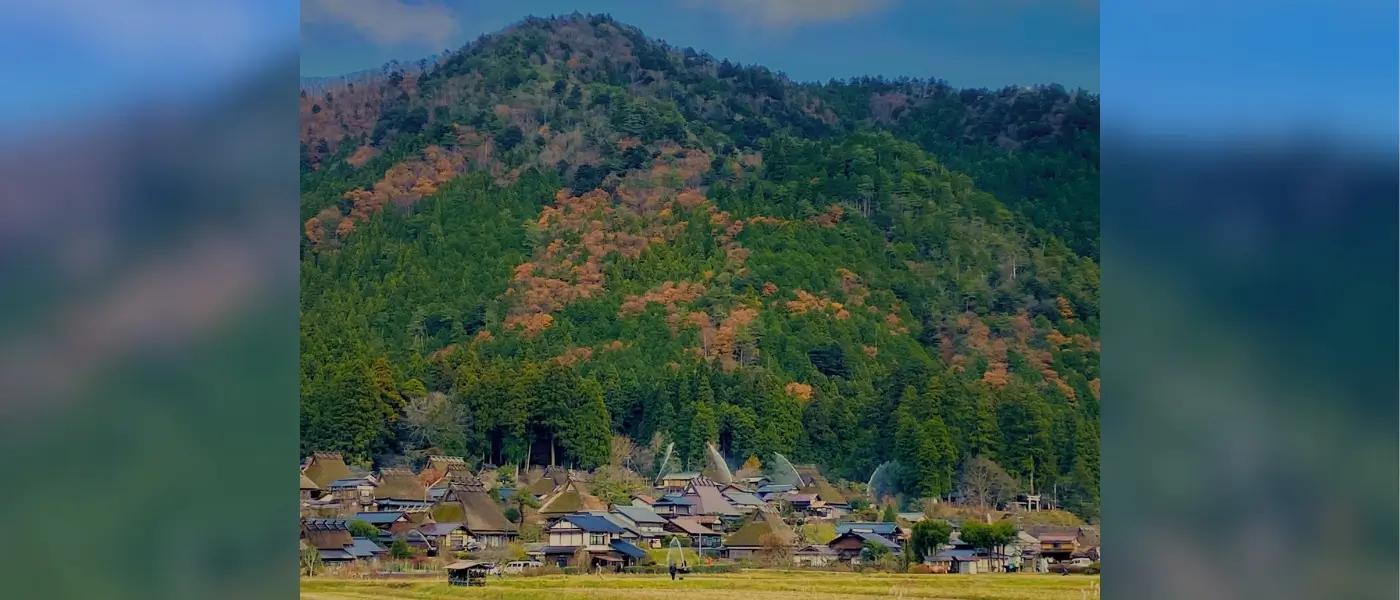
In Miyama, there was a group of about thirty households called tanomoshiko.
When a house needed a new roof, members of the group provided materials and labor.
All materials were prepared by the owner, and professional craftsmen were invited.
For each craftsman, about three assistants called tettai were needed.
These roles were also filled by villagers.
All of this support was based on lending and borrowing.
Each household kept records of these exchanges.
Money was not involved.
Each house had its own grass field on the mountainside.
In some villages, these fields were shared among relatives or by the whole community.
As long as there was sun, rain, wind, and soil, the grass grew naturally every year.
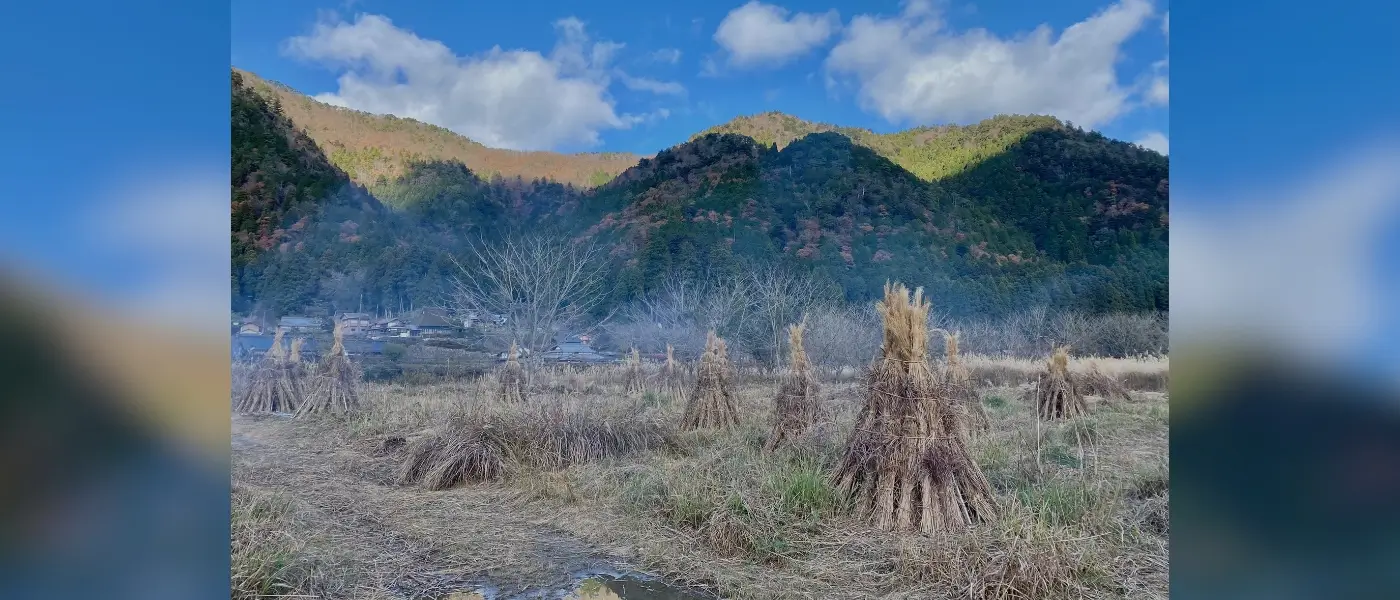
After the rice harvest in autumn, when frost appeared and the pampas grass turned from green to orange, families went out to cut thatch.
People in those days worked hard.
They would leave before sunrise, and by the time the sun came up, the mountainside would be covered with cut grass.
The cut grass was bundled to the thickness that could be held in both hands and tied in three places with straw.
At that time, the grass was still moist and heavy.
It was then stood upright in a cone shape and tied at the top to prevent rain from entering.
Left like this until April or May, the dry winter wind would naturally dry the grass.
In spring, families returned to the fields, carried the thatch home, and stored it in the attic.
Because the attic was dry, the thatch could be preserved for many years.
When rethatching began, scaffolding was built and the old thatch was removed.
By that time, the attic was already full of new thatch.
It could be brought out directly onto the roof and used immediately.
This was highly efficient, and the thatch was never exposed to ground moisture.

materials shaped by time and knowledge
Bamboo also has the right time to be cut.
The best period is from autumn to January.
In spring, bamboo absorbs nutrients, and if cut then, insects are more likely to infest it.
It must also be three to four years old.
Young bamboo is too thin and becomes weak when dried.
Rope was made from rice straw.
First, it was softened by pounding with a wooden mallet.
Then it was twisted by hand, adding more straw as it was braided.
This required great patience.
But even weak straw became strong rope when twisted.
During winter, villagers made these ropes inside their homes.
Around 1970, machines were invented to make rope, and they spread across the country.
However, handmade rope was stronger than machine-made rope.
Even today, when old roofs are dismantled, handmade rope can still be found.
Smoked by the hearth for over a hundred years, it becomes as hard as wire.
Rope was not only used to build the structure of logs and bamboo.
It was also the central element of the roofing process.
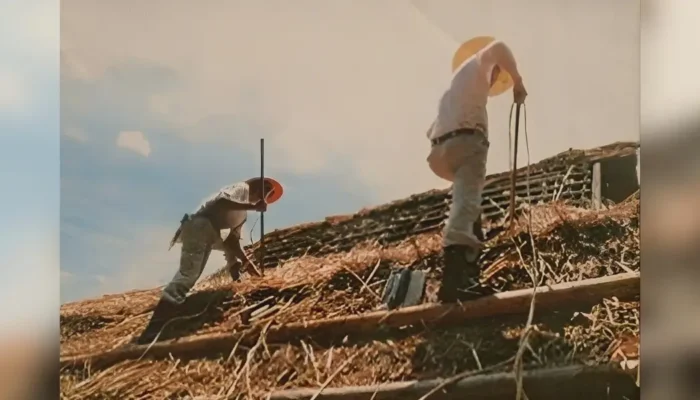
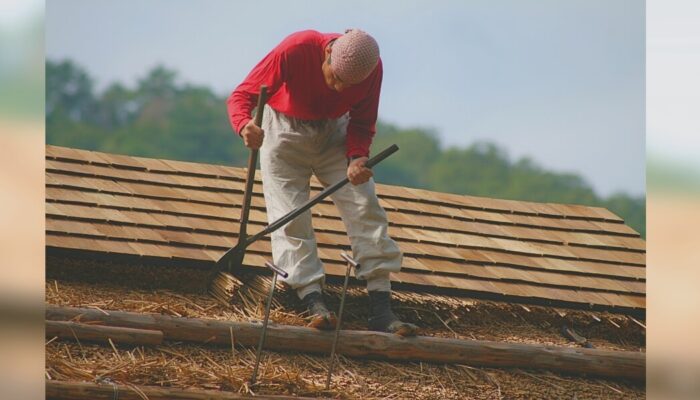
Craftsmen stacked thatch on the roof and held it down with bamboo.
They used a tool called a needle, a wooden handle with a hole at the tip, to pass rope through the roof from the outside.
Inside the attic, a person called hari-uke would receive the needle and pull the rope through.
This role was also performed by villagers.
The craftsman would then push the needle through again from the opposite side.
The rope would loop over the rafters and return.
This rope was then used to tie the bamboo and tighten the roof.
In such a system, people did not ask how many years a roof would last.
Thatch was supplied by nature every year.
As long as one belonged to the community and maintained good relationships, labor would naturally gather.
The structure of the house was strong.
As long as it did not leak, it could last a thousand years.
If there were no disasters and people remained healthy, the roof would continue to be maintained.
So instead of worrying about the lifespan of the roof, people valued maintaining good relationships within the village.
what sustains a roof
I would like to ask you something.
How long will your right arm continue to function as it does now?
Or your eyes, your ears, your fingers.
Most people do not worry about how long each part will last.
Because they know that if the body is healthy as a whole, each part will naturally repair itself.
For people in the past, a house and its roof were the same.
If the village as a whole was healthy, the roof would be maintained naturally.
However, while people may not worry about the lifespan of a body part, they do worry about their own lifespan.
Yet I feel that people in the past did not worry much even about their own lives.
I felt this strongly when I experienced a village funeral.
Around 1998, a villager passed away, and I experienced a traditional funeral for the first and last time.
Today, even in Miyama, funerals have become commercialized.
On the night before the funeral, all villagers gathered.
They prepared the altar and meals together.
The elders assigned roles for the procession and wrote them on large sheets of paper.
I helped prepare decorative paper for the altar.
We worked all night, but no one cried.
Everyone laughed and behaved as usual.
The next morning, people dressed according to their roles.
The head of the household wore formal clothing called kamishimo.
Relatives wore white garments, tied white cloths on their foreheads, and wore straw sandals.
The procession began.
At the front, several men walked while dragging bamboo sticks wrapped in white paper along the ground.
They made a rattling sound as they walked.
Perhaps it was meant to purify the space and drive away evil.
Behind them, another person carried a long bamboo pole with a basket at the end.
Every few steps, he struck the ground, scattering coins and candy.
Children ran to pick them up with joy.
I still do not know the meaning of this.
But it was clear that the funeral was not a sad ceremony, but something like a festival.
Behind them walked a monk.
I was given the role of holding a large red paper umbrella for him.
Further behind, relatives carried the coffin.
They walked through the village before placing the coffin in a hearse.
In the past, the body would have been buried directly in the village cemetery.
The person assigned to dig the grave was said to be the most respected.
In the afternoon, the ashes returned, and the villagers gathered again to chant sutras.
Then a feast began.
Again, people laughed.
No one cried.
Death was not something tragic.
Even after disappearing physically, the person remained in the village as a presence.
For the people of Miyama, death was not an end, but a continuation within the eternal life of the village.
I often describe human life as drops of water splashing from waves hitting rocks.
The drops rise into the air for a moment.
Then they return to the sea, become clouds, rain, and rivers.
Life is a brief form that appears within an endless cycle.
This is how I came to feel through living in Miyama.
the true meaning of sustainability
So let us return to the original question.
How long does a thatched roof last?
Modern people begin their thinking from this question.
But people in the past did not.
Instead of worrying about the lifespan of the roof, they valued maintaining relationships within the village.
If those relationships continued, the roof could always be repaired.
That was the true sustainability of traditional Japan.
Today, sustainability is discussed in terms of technology and environmental policy.
But for people in the past, sustainability meant maintaining relationships between the village, people, land, nature, and unseen forces.
If those relationships remained healthy, the roof, the house, and even life itself would continue.
That is why people did not worry about how long a roof would last.
What truly mattered was the continuity of human relationships.
If the village remained strong, the roof could always be rebuilt.
That was the sustainability of old Japan.
And even now, a faint echo of that way of life still remains in Miyama.